Achei essa maravilha do Shostakovich por acaso e está sendo difícil parar de ouví-la:
Encontrei essa preciosidade por acaso, pois é homônima de um nocturne do
próprio Shostakovich, que por sua vez vem a ser uma das coisas mais lindas e
surrealmente doces que já ouvi para piano:
(Algum conhecedor poderia me explicar por que as duas peças têm o mesmo nome? Não encontrei a resposta.)
Edit: procurei a informação. The Limpid Stream é uma peça para balé (ok, isso já é dito no vídeo do youtube). Mas será que o nocturne também faz parte da mesma peça? Isso eu ainda não encontrei.
5 de dezembro de 2012


19 de novembro de 2012
Psicografia? Sei…
I also find the difference between novice and experts psychographers to be very revealing. If psychography were truly a matter of entering a trance-state in which another entity were taking over and doing the writing, why would there be any activity of the brain areas involved in such writing, and why the difference between novices and experts? Either the psychographer is the source of the writing or some other entity is. I would expect, therefore, a binary result with “fakers” and true mediums showing completely distinct patterns of brain activity. There would also not be a direct relationship with experience, as you might have some experienced fakers and novice but genuine psychographers.
The pattern of results, however, is completely consistent with the conclusion that psychography is a performance by the psychographer, a skill that is developed over time like any other skill.
9 de novembro de 2012
Evento: lembrando Carl Sagan
Hoje, 9 de novembro, Carl Sagan completaria 78 anos.
À 1h da madrugada no Brasil, 7h da noite na Califórnia, haverá um evento em homenagem ao Carl, que poderá ser assistido abaixo.
O evento contará com a participação do físico Kip Thorne, da produtora Lynda Obst (importante figura no final da vida de Sagan) e do brasileiro Wladimir Lyra, astrônomo, Sagan Fellow no JPL/NASA, que pesquisa discos protoplanetários (uma das coisas mais interessantes para se estudar em astronomia, hoje, na minha opinião de leigo).
Quem sabe posso até aproveitar algo para a minha dissertação de mestrado sobre o Sagan, ainda em curso, que pretendo defender em breve.
7 de novembro de 2012
United States of Ohio (9)
Obama deu uma galopada no final da apuração do voto popular, como é chamada a contagem que deveria decidir a eleição, mas não decide: 60,4 milhões, contra 57,6 de Romney. 2% de diferença.
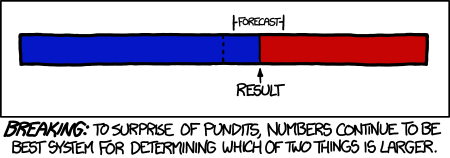
Até nisso o Nate Silver acertou.
Silver foi atacado pesadamente, nos últimos dias. Seus cálculos de probabilidade, que apontaram o favoritismo de Obama nos swing states durante a reta final, foram desqualificados pelos analistas da mídia conservadora, reis na opinião e párias nos fatos.
Racionalidade, 1 a 0.
Atualização: abaixo, a última do xkcd!
United States of Ohio (8)
Como é bom ver essa gente espernear.
Faz tempo, a Fox News vem criando ficções com roupa de realidade para uma enorme fatia da população americana. Em sua versão fictícia do mundo, há doses generosas de paranoia e conspiracionismo refogadas num caldeirão nacionalista que beira o fascismo.
Obama acabou de discursar. O mote: o país está rachado e devemos cuidar para que não seja assim. Desconfio que isso não seja apenas fruto da necessidade protocolar de louvar a unicidade de uma nação após uma campanha acirrada pelo poder.
Só agora, com 85% das urnas apuradas, Obama ostenta a liderança na contagem geral de votos. Pouco mais de 100 mil votos o separam de Romney, num universo de uns 120 milhões de eleitores votantes. Essa deverá ser a eleição mais apertada, nesse quesito, desde Nixon e Kennedy, ou Dewey e Truman, não sei.
Bem mais de 50 milhões de pessoas votaram contra Obama. A maioria delas vive dentro de uma bolha de fantasia reacionária, conscientemente reforçada por um cínico modelo de negócios no ramo da desinformação e da mentira, inflamada com sentimentos de medo, territorialidade, etnocentrismo e individualismo, caracterizada por uma persistente falta de percepção do outro, manifestada como intolerância religiosa, como racismo e como um incompreensível desdém por toda miséria humana.
Nada garante que, com uma economia agonizante, esse discurso reacionário se enfraqueça. Pelo contrário.
Por isso, é momentaneamente tranquilizador que o moderadamente conservador Obama tenha conseguido se manter no poder. Mas é perturbador que um discurso tão desconectado da realidade quase o tenha derrubado. Um clima ideológico cada vez mais envenenado pelo cinismo no maior poder bélico e nuclear do mundo não é boa coisa.
“Estamos” quase todos fudidos, disse alguém num comentário por aqui.
Pode ser. Pode bem ser.
Estão brincando com fogo.
United States of Ohio (7)
A Fox News já incluiu Ohio na conta do Obama. Se o diário oficial do Partido Republicano já concedeu, o que mais falta? Nada.
Quase todos os swing states estão indo para Obama. Até mesmo a Flórida, e por só 40 mil votos.
Só resta saber se Obama vai virar o placar nos votos totais, o que deverá fazer quando a Califórnia for apurada. Mas isso não vale porra nenhuma.
A direita sã com face humana continuará governando. A direitaça reaça religiosa irracional fascista vai ficar de fora por mais quatro anos, embora tenha carregado novamente a Casa dos Representantes (Câmara dos Deputados). Vão fustigar o Obama por mais dois anos. Quem pagará a conta? Não vai ser o 1% mais rico da população.
Estão quase todos fudidos.
United States of Ohio (6)
O Estadão está com o site de apurações super-rápido. Mais rápido que o NYT.
Flórida, 85% dos votos apurados: a liderança do Obama vai a 13 mil. Não significa muita coisa, ainda.
Ohio, 1/3 das urnas apuradas: vantagem de Obama em pouco mais de 4%. Caiu um pouco, mas de quais áreas estão vindo os votos? Eis a questão. A boca de urna deu Obama por uma vantagem similar à que ele tem agora.
United States of Ohio (5)
7 milhões de votos apurados (mais de dois terços) na Flórida e Obama lidera por menos de 2 mil votos.
Obama pode se dar ao luxo de perder a Flórida. Romney, não.
Nate Silver lembra que o condado onde fica a cidade de Tampa é um dos mais importantes pois geralmente quem o leva, leva o estado. Obama está na frente, lá.
E Ohio? Obama tem uma margem segura na liderança, 8%, embora apenas 16% dos votos já foram apurados.
6 de novembro de 2012
United States of Ohio (4)
Nate Silver, o estatístico do NYT, começou há pouco seu live-blog da apuração das eleições americanas.
Esse cara é bom. A análise que ele faz é extremamente pormenorizada. Fiquemos de olho no que ele diz sobre os resultados iniciais de Virgínia e Flórida.
Esse cara é bom. A análise que ele faz é extremamente pormenorizada. Fiquemos de olho no que ele diz sobre os resultados iniciais de Virgínia e Flórida.
United States of Ohio (3)
Esses caras do Independent pegaram o espírito da coisa:
Que dê Obama. Mas com pitadas do drama daquele clássico de 2000, Gore vs. Bush. (Embora recontagem já seja pedir demais).
“As soon as your TV network of choice calls a state as red or blue – take a drink of that colour. This may be red or blue packaging (eg, Budweiser and Brooklyn beers) or the drinks themselves (eg Chambord and curacao). If you opt for the latter pairing, don't expect to be conscious when they call Colorado at 5am.”Poucas coisas são tão divertidas quanto a apuração das eleições americanas.
Que dê Obama. Mas com pitadas do drama daquele clássico de 2000, Gore vs. Bush. (Embora recontagem já seja pedir demais).
Acid Rain
“The Human Rights Commission of Pakistan reported 943 women were murdered in honour killings last year, an increase of more than 100 on 2010. But it may be that both honour assaults and acid attacks are even more prevalent. The commission's spokesman, Zaman Khan, said recently that it is suspected that many such offences are not reported.”
Da notícia no Independent: Pais que mataram a própria filha com ácido dizem que era o destino dela [morrer dessa forma].
United States of Ohio (2)
A terça-feira começa com 92,1% de chances de vitória de Obama em Ohio, e 92,2% de chances de vitória no Colégio Eleitoral, segundo Nate Silver.
Detalhes de menor importância: Colorado e Virginia com mais de 80% de chances de irem para Obama. Eram indefinidos até uma semana atrás. Até a Flórida passou para o lado do Obama, pro Nate.
Já era. O negão tá reeleito. Chupa, direitaça religiosa reaça.
Amém
“We have desperately to find our way back to human values. I would even say to religion. There is nothing supernatural in my mind. Nature is my religion, and it´s enough for me… What I mean is: We need some widely shared view of the place of Man in the Universe.”
George Wald, citado por Carl Sagan em The Cosmic Connection.
Tradução livre: “Nós precisamos, desesperadamente, encontrar um caminho de volta aos valores humanos. Eu diria, até, à religião. Não tenho nada sobrenatural em mente. A natureza é minha religião, e isso é o suficiente para mim… O que quero dizer é: Nós precisamos de uma visão largamente compartilhada sobre o lugar do Homem no Universo.”
Amém.
31 de outubro de 2012
Como tem cara-de-pau no mundo…
“Deixem o Deus Mercado cuidar das áreas afetadas por desastres naturais”. Sem brincadeira, é essa a ideia do cidadão.
Mas não só dele. Sabe quem defendeu a mesma coisa, há uns meses atrás?
Mitt Romney.
Mas não só dele. Sabe quem defendeu a mesma coisa, há uns meses atrás?
Mitt Romney.
26 de outubro de 2012
Família do premiê chinês se locupleta espetacularmente
Baixe aqui a versão completa (para quem já estourou o limite de visualizações) da matéria do New York Times, veiculada ontem, sobre o enriquecimento meteórico da família do premiê chinês, Wen Jiabao.
A longa, excelente matéria de David Barboza traz “an unusually detailed look at how politically connected people have profited from being at the intersection of government and business as state influence and private wealth converge in China’s fast-growing economy.”
Vale a pena, a leitura.
Atualização: a China bloqueou o acesso ao artigo do NYT, diz o jornal.
25 de outubro de 2012
United States of Ohio
As campanhas não triscam perto da Califórnia, Texas, Nova York, Illinois, Georgia…
Todos os presidentes eleitos desde 1964 levaram Ohio.
Quem levar Ohio, em novembro, estará na Casa Branca em 2013.
Segundo Nate Silver, Obama tem 74% de chances de levar Ohio, hoje. Aparece 5 pontos à frente, no estado.
O Colégio Eleitoral, que favoreceu Bush em 2000, pode dar uma vitória aos democratas mesmo com estes sendo derrotados no voto popular. Romney pode até levar a Flórida (como parece que vai), ser o mais votado nacionalmente (como é bem possível que ocorra) e sair derrotado.
Ainda bem. Mas é uma piada, não é?
22 de outubro de 2012
Como não sentir o terror?
Gostaria de ser racional como o sujeito que escreveu isso, mas não consigo. Não faz sentido, eu sei, mas e daí?
[…] Suppose you're at a party. It's great, and you wish you could stay, but this is taking place in high school, and your mother is going to call and tell you it's time to go home. Now, there's nothing bad about being at home; it's intrinsically neutral. You just wish you could stay at the party.
Suppose you know that the call is going to come at midnight, guaranteed. Then, I think, there isn't anything to be afraid of. But if all you know is that your mother is going to call some time between 11 pm and 1 am, the conditions for appropriate fear have been met. There is something bad, there is a non-negligible chance of it happening, and yet there is also a lack of certainty that it will happen. Now some degree of fear makes sense. Perhaps we have something similar with regard to death. Perhaps it makes sense to be afraid given the unpredictability of death.
Further distinctions might be helpful. Am I afraid that I will die soon, in the sense that, given the range of years I might reasonably hope for, death may come sooner rather than later? Or am I afraid that I will die young, with death coming sooner for me than it does for others? These ways of specifying the object of my potential fear differ in important ways, including how much fear is appropriate, and when.
Take the fear of dying young. Clearly, if you have reached middle age any fear of dying young is irrational. But even among the young, the chance of this actually happening is extremely small.
As one grows older, the chance of dying within a given period increases. But even here, fear that one will die soon can easily be out of proportion. Even an 80-year-old has a more than 90 per cent chance of living at least another year.
Obviously, fear that death may come soon can make sense among the very sick or the very aged. But for the rest of us, I think, it is typically misplaced. If you are reasonably healthy and yet you say to me, "I am terrified of death", then all I can say in response is that I believe you, but terror is not appropriate. It doesn't make sense, given the facts.
16 de outubro de 2012
Oh, Canadá…
Se tucanarem e não condenarem o governo conservador canadense depois dessa, os acadêmicos libertários relativistas podem ir para o espaço – embora não dê pra ir pro espaço sem ciência.
O artigo abaixo é Governando no escuro: a perigosa revolução anticientífica de Ottawa, de C. Scott Findlay. Vai na íntegra. Não dá pra ficar pondo reparos epistemológicos quando a guerra é aberta e suja.
_____
Governing in the dark: Ottawa’s dangerous unscientific revolution
Most Canadians understand that our well-being depends on science. But Canadian science is under assault. And scientists, like Peter Finch in the film Network, are mad as hell. In July, more than 2,000 of them staged a mock funeral for scientific evidence on Parliament Hill to protest the Harper government’s dismantling of Canadian institutions that collect scientific evidence, the muzzling of government scientists, and the erosion of the role of scientific evidence in public debate and regulatory decisions.
The rally was covered by news media across Canada and around the world. Nature, perhaps the world’s premier science journal, ran a lead editorial on the event, concluding: “If the Harper government has valid strategic reasons to undermine vital sectors of Canadian science, then it should say so . . .”
Predictably, the next day Minister of State for Science and Technology Gary Goodyear issued a hasty press release pointing out that the last budget included a $1.1 billion investment in science. Even the lay public saw through this embarrassingly transparent attempt to dodge the issue, which was about the gathering, unfiltered dissemination and use of scientific evidence, not about the funding of science writ large.
Even so, close examination of the $1.1 billion investment shows that much has been allocated to industry and commercial science partnerships. Meanwhile, the proportion of funding allocated to basic research, such as the budget of the Discovery Grants program of the Natural Sciences and Engineering Research Council, has been dropping steadily since 2006.
The science enterprise is like a pyramid. At the base are scientists engaged in the importunate probing of nature’s corpus — say, characterizing the molecular signalling pathways whose activation predisposes cells to become cancerous. Balancing on their shoulders are scientists who apply this knowledge to existing problems — say, developing a cancer drug that will block some of these signalling pathways. And teetering at the apex are scientists engaged in the industrialization of applied research — say, finding efficient ways of producing cancer drugs in large quantities at a reasonable price.
As children, we learned that the larger the base, the taller the pyramid that can be supported: the more basic research, the more opportunities for commercialization and industrialization. Moreover, an uneven base — areas of science where there is comparatively little basic research — not only means no corresponding opportunities for application or industrialization but, worse still, increases the chances of the whole structure toppling over. So too does overloading the top levels: after all, even the most robust basic scientist can support only so many of her applied and industrialization colleagues on her shoulders.
There are at least four reasons why all Canadians should repudiate Prime Minister Harper’s systematic erosion of science capacity in some areas, and more generally, his repudiation of scientific evidence.
First, true democracy is possible only with a well-informed and skeptical populace. And it is scientific evidence that informs, and the spirit of scientific inquiry that motivates, this essential constructive skepticism.
Second, the repudiation of scientific evidence is a de facto rejection of one of humanity’s greatest intellectual pursuits. It is a slap in the face to the hundreds of thousands of science students in high schools, colleges and universities — and the spirit of intellectual curiosity and imagination that motivates them. In short, it undermines the intellectual capacity on which the future progress of Canadian society depends.
Third, there are areas of basic and applied research which are enormously important for the welfare of Canadians yet for which there is little potential for industrialization or commercialization — for example, the science that informs how best to protect both ourselves and our environment from the unsalutary consequences of the industrialization and commercialization of scientific knowledge.
Fourth, our tax dollars go to support programs and policies that are designed, we are told, to achieve certain goals. The more scientific evidence that is considered in taking decisions, the more likely we are to achieve desired goals and avoid undesired consequences.
Evidence-free decisions are merely uneducated guesswork. Scientific evidence is a form of insurance, a comparatively inexpensive yet effective way to ensure that much larger investments in government programs are not wasted, that opportunities are not squandered, and that others will not have to shoulder the burden of (whoops!) undesired and unanticipated consequences. In other words, scientific evidence forms the basis for true public accountability. And isn’t accountability the horse on which Harper rode into Parliament?
C. Scott Findlay is an associate professor in the biology department at the University of Ottawa and a visiting research scientist at the Ottawa Hospital Research Institute.
15 de outubro de 2012
A sonata mulattica
A história é deliciosa e a música, melhor ainda.
Ranulfus, do PQP Bach, conta a história da sonata para violino número 9, conhecida injustamente como Sonata a Kreutzer (até Tolstói escreveu inspirado por ela e deu ao seu livro o mesmo injusto, mas popular, nome). A peça é resultado do encontro musical e etílico entre um Beethoven ainda mais ou menos jovem e a improvável figura do violinista virtuose George Bridgetower, um mestiço com um pé nas cortes européias e outro na escravidão negra do Caribe:
Aos 25 anos, em licença, George chega a Viena, onde Beethoven, com 33, já pontificava. A amizade parece ter sido imediata, informal e entusiástica: Beethoven retoma alguns esboços, e em uma semana conclui a nona e mais importante das suas sonatas para violino e piano. Vão estreá-la juntos em 25/05/1803, com Bridgetower – acreditem ou não – tocando boa parte à primeira vista, e ainda lendo por sobre o ombro do compositor, pois nem tinha havido tempo para copiar a parte do violino.
Mas o melhor da história vem no segundo movimento, quando o piano reapresentava sozinho uma idéia exposta antes pelo violino – e Bridgetower ousou improvisar comentários uma oitava acima em vez de aguardar. Beethoven teria saltado do piano e… ao contrário do que se poderia esperar do seu gênio, teria abraçado o violinista com palavras que se traduzem perfeitamente por “Mais, camaradinha, mais!” – o que me faz perguntar: terá sido essa a primeira jam session da história?
Que o clima era de divertimento, atesta-o também o título que aparece no manuscrito original: nada menos que “Sonata mulattica, composta per il mulatto Brischdauer [grafia jocosa do nome], gran pazzo [grande maluco] e conpositore mulattico” – havendo referência ainda à anotação “Sonata per un mulattico lunatico”.
Tão informal, porém… que segundo um relato da época os dois teriam comemorado a estréia com uma bebedeira homérica, no meio da qual Beethoven teria se dado por ofendido por uma observação de Bridgetower sobre determinada mulher… A amizade teria terminado aí, e seria por isso que pouco tempo depois Beethoven enviou a sonata com dedicatória ao francês Rodolphe Kreutzer, violinista mais famoso da época.
Outros veem uma razão mais pragmática: com brigas ou não, Beethoven planejava uma temporada em Paris e pensou que dedicar a sonata a Kreutzer podia ajudar no projeto. O fato é que a viagem não se concretizou, e Kreutzer, por sua vez, apenas passou os olhos e disse que a obra era um nonsense inexecutável, e que de resto não lhe interessava porque ‘nem era virgem’ (a expressão é minha)… Nunca tocou a peça que imortalizou seu nome injustamente, enquanto o de Bridgetower só recentemente vem sendo recuperado.
Um bundão, enfim, o tal de Kreutzer. E gran pazzo, o Bridgetower.
Mas vamos ao que realmente interessa.
A música é simplesmente irresistível; pega o teu ouvido de primeira e não larga mais. Abaixo, ei-la completa nas mãos da grande pianista Martha Argerich e do violinista Gidon Kremer.
9 de outubro de 2012
Assinar:
Postagens (Atom)
